


After we demonstrated the Jordan Kingsway loudspeaker at the HiFi Live Show last September, we received a call from audio journalist Steve Harris. The conversation resulted in Steve’s Opinion column about bipole and reflecting speakers in the current issue of Hi-Fi News (dated March 2026). As usual, Steve raised some interesting points, which we thought were worth exploring further. References and links are given at the foot of the article.
Loudspeakers that use room reflections have a long history. Commercial attempts began in the days of mono. Models such as the 1949 Decca Corner Horn (ref 1, below) had the drive unit facing into a corner to fill the room with sound. Other models from Wharfedale and Harman Kardon (2, 3) used diffusers to give an omni-directional spread of sound.
This omni-directional idea was developed further by Stig Carlson with his Sonab range, launched in 1966 (4).

Sonab speakers were neat, room-friendly designs based on what Carlson described as the ortho-acoustic principle, which relied on a mix of room boundaries and omni-directional dispersion to enable a listener to enjoy stereo throughout the room.
It was a controversial idea. The Sonab OA5 received a sceptical review from Donald Aldous in Hi-Fi News (5) and the magazine’s editor, John Crabbe, argued strongly against the idea (6). But public curiosity was substantial and Hi-Fi News reported at the time that the Sonab room was always packed at the London Audio Fair.
Later models like OA-12 (1975–1979) and OA-116 (1975) refined the concept with improved direct/reflected sound balance.
Sonab loudspeakers remained in production until 1979. Today, Larsen Loudspeakers continue to develop Sonab’s principles (7). Fully omni-directional speakers are still available, with perhaps the most successful proponent being the German Physiks loudspeaker company with their successful development of the Walsh driver. (8)
Meanwhile, back in 1968, Amir Bose launched the Bose 901, probably the most famous – or notorious, depending on your viewpoint – loudspeaker to rely on listening room reflections.

Bose’s key argument was that as 90% of what we hear in the concert hall arrives at our ears via reflections within the hall, the same should occur with music reproduced by loudspeakers in the home. So he turned his speakers around and pointed them at the wall.
The 901 used nine full-range drivers with eight facing away from the listener, towards the wall, and one facing the listening position. This, Bose argued, gave the correct balance of direct vs reflected sound.

Hi-Fi News gave the 901 a mixed reception. John Crabbe disliked the presentation but Ralph West’s detailed review in the July 1971 issue concluded that he liked the effect and thought it a very clever idea (9). Whatever its merits, it remained in production until 2017 and is the most successful of its genre.
Meanwhile, in Canada, a different approach was being taken: the bipole loudspeaker. (10)
In a bipole loudspeaker, there are identical drive units on the front and rear. They operate in phase, giving the same output from each, so the speaker sends the same sound wave into the room from both front and back. This has a number of significant benefits:
– The speaker gives a much broader power response into the room, i.e. the same energy at all frequencies goes into the room, something which only occurs with bass frequencies in a traditional, monopole design (drivers only on the front).
– This helps to give a more consistent tonal balance throughout the room, helping it to sound more natural.
– In addition, reflections from the sides sound the same as the signal directly from the speaker, adding a spacious effect to the sound.
Founded in 1977, the Canadian company Mirage began by making relatively conventional, monopole loudspeakers. They were good but didn’t set the world alight. In the 1980s, they worked with the Canadian National Research Council to research what influenced listener preferences in a loudspeaker. In 1987, this led to the launch of the M-1, the world’s first bipolar loudspeaker.

Reviews of Mirage speakers in Stereophile and elsewhere were positive. In fact, in 1989, Absolute Sound magazine ranked it as their speaker of the decade. (11)
Renowned loudspeaker researcher Floyd Toole (who also worked closely with the Canadian National Research Council) used them as his home references for a while. (12)
In fact, it was Toole’s mention in his book which pointed to potential benefits if a bipole design were to be used with the Jordan Eikona wideband drive unit.
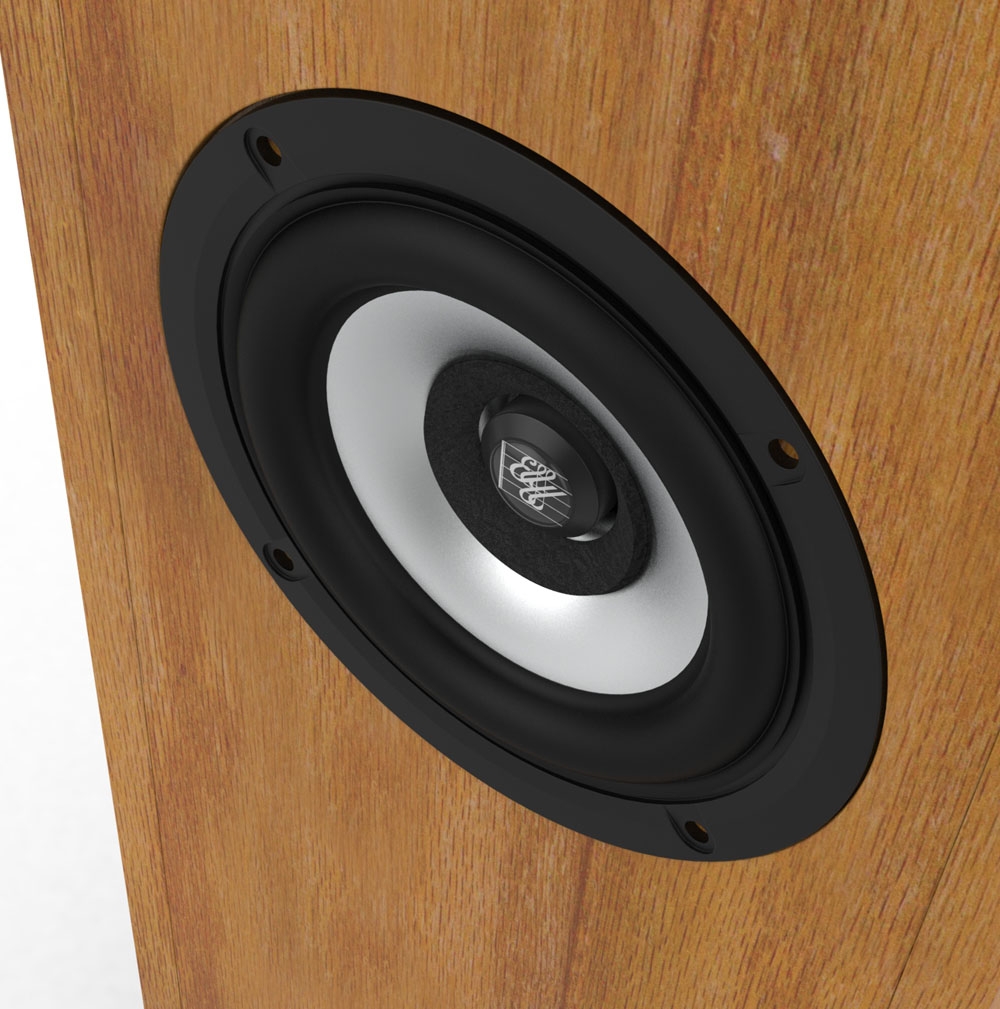
A good wideband drive unit has a number of advantages over the more common multi-driver approach:
– all the sound comes from one point
– it is in phase
– and it sounds very coherent.
It’s a fact of physics that the dispersion of sound from such a cone narrows with increasing frequency. This is why most multi-driver systems commonly have a dome tweeter to spread the high frequencies. The 100 mm cone of the Eikona gets increasingly directional above 3-4 kHz. This has advantages and disadvantages.
You can use this to advantage if you adopt the Hugh Brittain method of positioning loudspeakers. (13)
This requires the axis of the stereo speakers to cross well in front of the listening position. With the right dispersion characteristic from the drive units (a 100 mm cone Eikona, for instance), it gives a stable stereo effect over a wider area.

As you move left, you leave the axis of the lefthand speaker but come into the direct axis of the righthand one. This compensates for the left speaker getting louder because you are closer to it. A central stereo image stays central rather than wandering over to the left.
Try this at the next demonstration you attend; it is surprising how few speakers can do it.
However, the HF focus and stereo dispersion of this approach can lack some of the air and spaciousness of wide-dispersion loudspeakers.
In both Mirage’s and Toole’s research, when testing different loudspeakers in a controlled environment, listeners showed a marked preference for models with a balanced off-axis response which includes some side wall reflections. (This may explain why a number of audiophiles prefer to fire their speakers straight down the room, rather than turned in.)
Would it be possible to combine the stereo focus of something like the Eikona with the spaciousness heard from wide-dispersion speakers?
Out came the white coat and measuring sticks.
Experiments at EJJ Loudspeaker HQ over the course of several months made it clear that a bipole design had considerable merit. Adding rear-facing Eikonas contributed to the sense of space around the imagery and was very beguiling. With care, the main imaging of the front speakers was hardly affected. On to more carefully considered prototypes …
On the subject of loudspeaker enclosures, Ted Jordan was always a firm advocate of wider rather than deeper. As it happens, this is ideal for a bipole loudspeaker, which ideally is at least 1-2 times wide than it is deep. Similar, in fact, to our existing VTL design, so we used that as the form of the early prototypes. (14)
Placing an Eikona on the front of the enclosure and angling it inwards at 60 degrees gave the focus and precision of the Hugh Brittain arrangement, whilst a balancing Eikona to the rear improved the power response and obviated any requirement for a baffle step circuit. (15)
It incorporated the space and air suggested by Mirage and Toole, and showed enough potential for us to develop a final version for the 2025 UK Hi-Fi Show in Daventry.
The result is our Kingsway loudspeaker.
This features two pairs of Eikonas for increased power handling and increased efficiency, one pair on the front and one pair to the rear, set lower down. They have the same frequency response forward and back, and operate in phase.

The increased sensitivity afforded by four Eikonas greatly decreases any residual distortion and they sound notably clean and relaxed. Angling the speakers inwards keeps the axis crossed in front of the listener, so the main image remains pristine.
The cabinets are constructed by a Cumbrian cabinet maker, using the thin-wall, critically-damped technique used in our Marlow and Greenwich, but with additional refinements. The cabinets have a balancing veneer on the inside and the exterior Italian veneers are actually two layers, to give further damping and allow a small radius at the cabinet edges.

Combined with the internal treatment, large base and the specialised, damped feet, it makes for a very substantial, musical-sounding loudspeaker. Sadly, not an inexpensive one but then it was always intended as a reference …

The Kingsway has now been demonstrated at three hi-fi shows, usually angled 60° in and placed several metres apart along the longest wall. This may look visually unpromising (“You’ve got your speakers in the wrong positions,” said one visitor, before hearing them) but it sounds marvellous, with a wide, deep soundstage and focused image.
Visit the Kingsway page for comments from visitors at recent shows.
It’s been a long journey to the Kingsway, but it’s enabled us to arrive somewhere very interesting. Bipole loudspeakers have very definite benefits. We hope you’ll take the opportunity to hear ours when we next exhibit them. If you would like to hear them, please contact me to make an appointment for a demonstration at our HQ in Cumbria.
References – where available, click the links for more information:
(1). Decca Corner Horn, designed by Ralph West and first produced in 1949. A constructional version by him appeared in Hi-Fi News, March 1959. A PDF is available here.
(2). Harman Kardon HK-50 loudspeaker
(3). Harman Kardon Citation X advert., Audio, December 1960
(4). For the best history of Stig Carlsson and Sonab, visit Carlsson Planet.
(5). ‘Sonab OA5 Omnidirectional Loudspeaker’ by Donald Aldous, Hi-Fi News, November 1970
(6). ‘In All Directions’ by John Crabbe, Hi-Fi News, April 1971,
(7). This Absolute Sound review of the Larsen Model 8 by Robert E. Greene gives a good idea of its operating principles.
(8). The German Physiks website is a good place to learn about the4 Walsh driver and their omnidirectional approach to loudspeakers.
(9). ‘Bose 901 Loudspeaker System’, Ralph L. West, Hi-Fi News, July 1971
(10). Bipole vs dipole. A bipole speaker has front and rear drivers in phase, so the sound is pushed out as a sphere. A dipole usually has a driver mounted in a baffle with the back open, so the rear radiation is out of phase with the front. This results in a figure of eight radiation pattern, with little sound to the sides.
(11). Mirage M-1 review, Stereophile, June 1989.
(12). Floyd E. Toole, ‘Sound Reproduction’, Routledge, 3rd edition 2018.
(13). Hugh Brittain was head of research at GEC’s Wembley Laboratories in the 1950s and responsible for GEC’s innovative, metal cone loudspeakers. In the UK, he is known for the extreme ’toe-in’ approach to loudspeaker placement.
(14). Duke LeJeune described the advantages of bipole speakers in an article in June 2010 on the HiFiZine website. He stressed the importance of the width of the cabinet and the value of off-setting front and rear loudspeakers so they are at different heights, reducing the cancellation effects measured by in some of the Mirage Stereophile reviews.
(15). Sound from a standard loudspeaker – with drive units on the front of the enclosure – will radiate in all directions at low frequencies, with half wrapping around the speaker, and not arriving directly at the listener. Higher frequencies – depending on the width of the baffle – will be projected forwards, increasing sound pressure at the listening position and sounding louder. This is known as the baffle step. The wider the baffle, the lower the frequency at which it occurs.
The common way to counter this is to incorporate a baffle step circuit, which pulls down the higher frequencies to match the lower. We have done this with our Marlow EV and Greenwich loudspeakers. A bipole speaker does not suffer from this problem, so no baffle step circuit is required.